
PKB Solutions logo

Working with us

Start with a scoped conversation

Tell us the outcome you are chasing and we will map it to a realistic first phase.

Contact the team
PKB Solutions logo
Home

Integrations

Amplify

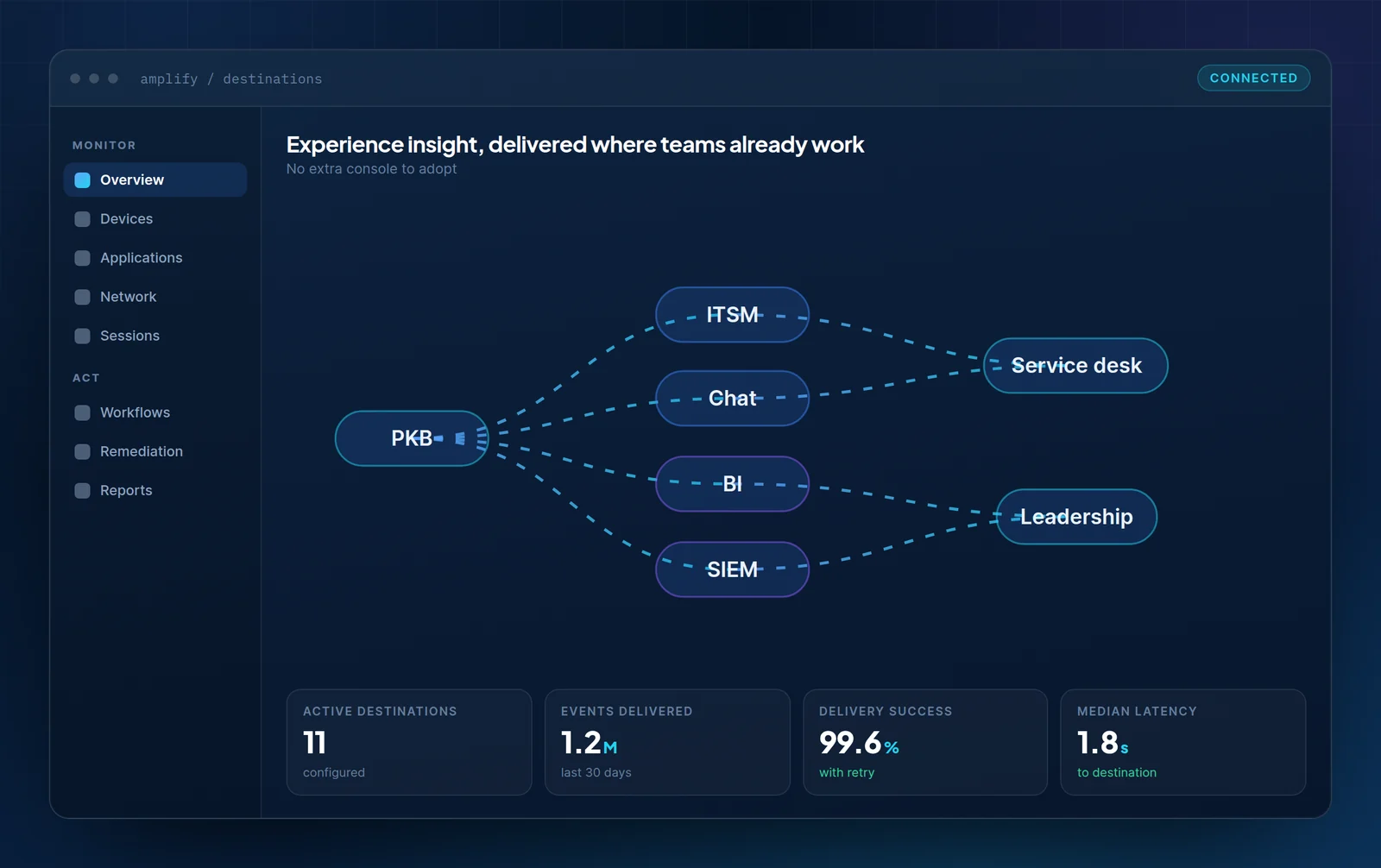
The fastest way to make an insight useless is to put it in a console nobody opens. Amplify delivers it where the work already happens.

Amplify integration map routing PKB signals into ITSM, chat, BI and SIEM destinations, with delivery volume and success metrics.

What it covers

Adoption is a distribution problem

Every additional console is a tax on the team that has to check it. Amplify assumes your teams will not adopt another one, and routes to what they already have open.

Rule-based routing

The right signal to the right destination, filtered by condition rather than broadcast to everything.

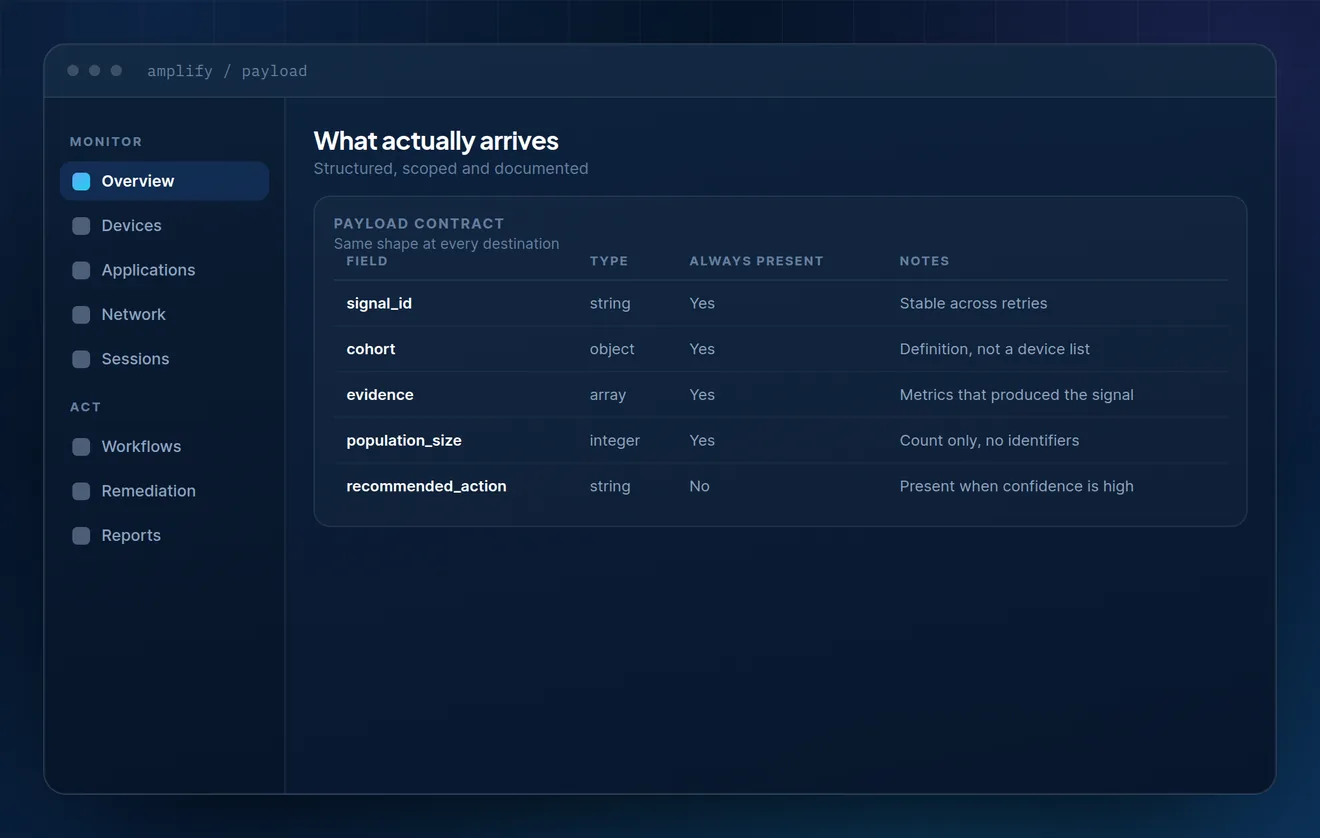
Consistent payload

The same documented structure at every destination, so downstream automation does not need per-system handling.

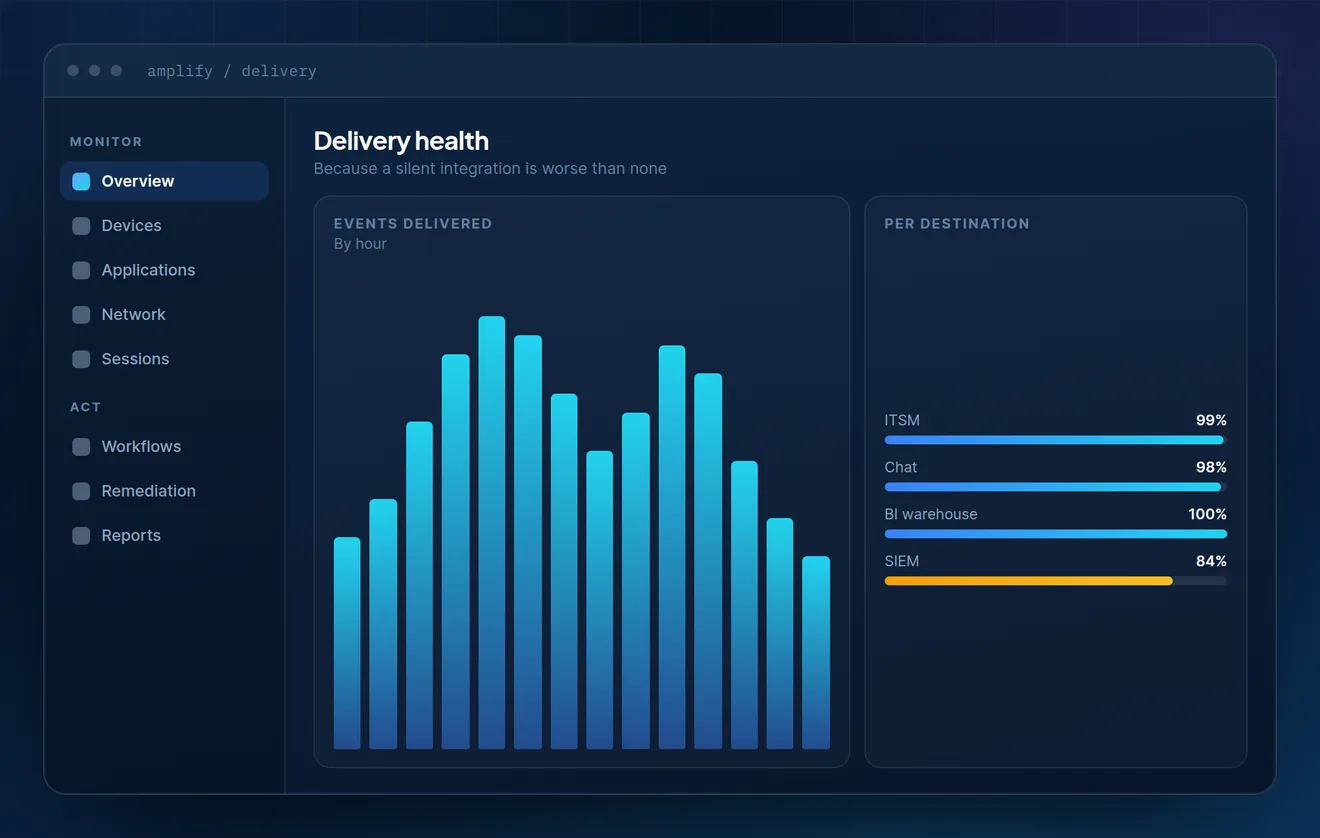
Delivery health

Success, retry and latency per destination, because a silent integration is worse than no integration.

Scoped content

Cohort definitions and counts, not device or person identifiers, unless the destination explicitly requires them.

Capabilities

Discover key features

Routing, delivery and payload — the three things that decide whether an integration is trusted.

Routing rules table mapping signal types and conditions to ITSM, chat, BI, SIEM and asset destinations.
01

Routing

Filtered at source, not at the destination

Conditions are evaluated before delivery, so a queue does not fill with signals the receiving team has no ability to act on.

  • Condition-based rules per signal type
  • Separate destinations for separate audiences
  • Rules testable before they go live
Delivery health view with events delivered by hour and per-destination success meters for ITSM, chat, BI warehouse and SIEM.
02

Reliability

You will know when it stops working

Per-destination delivery health with retry behaviour. Integrations fail quietly by default, and that is usually discovered weeks later.

  • Success rate and latency per destination
  • Retry with backoff, then an alert on persistent failure
  • Delivery volume visible by hour
Payload contract table listing fields, types, whether each is always present, and notes on their contents.
03

Payload

One documented contract

A stable field structure with an explicit statement of what is always present and what is conditional, so downstream systems can be built against it safely.

  • Field-level documentation including optionality
  • Stable identifiers across retries
  • Population counts rather than device lists

Where it lands

Four destinations, four different needs

ITSM

Device context attached at ticket creation, so the first response is diagnosis rather than data gathering.

Chat

Forming signals pushed to the endpoint engineering channel while the cohort is still small.

BI warehouse

Scores and distributions on a schedule, joined to your own business dimensions.

SIEM

Correlated authentication and configuration anomalies, scoped to what the security team can act on.

Bring your destination list

Tell us which systems your teams live in. We will show you what would be delivered to each and what the payload contains.